What Did Confucius Teach Was Key to Having a Strong Family and a Great Society?
| Confucius | |
|---|---|
| 孔子 | |
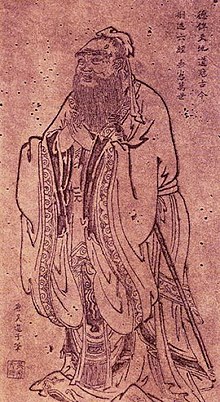 The teaching Confucius. Posthumous portrait by Wu Daozi (685–758), Tang dynasty. | |
| Born | Kǒng Qiū c. 551 BCE Zou, Country of Lu |
| Died | c. 479 BCE (aged 71–72) Si River, Land of Lu |
| Resting place | Cemetery of Confucius, Country of Lu |
| Era | Hundred Schools of Idea (Ancient philosophy) |
| Region | Chinese philosophy |
| School | Confucianism |
| Notable students | Yan Hui, Zengzi Disciples of Confucius |
| Chief interests | Ethics, Education, Music,[1] Poetry,[ii] Political philosophy, Social philosophy |
| Notable ideas | Confucianism, Golden Dominion |
| Influences
| |
| Influenced
| |
| Confucius | |||||||||||||||||||||||||||||||||||||||||||||||
|---|---|---|---|---|---|---|---|---|---|---|---|---|---|---|---|---|---|---|---|---|---|---|---|---|---|---|---|---|---|---|---|---|---|---|---|---|---|---|---|---|---|---|---|---|---|---|---|
 "Confucius (Kǒngzǐ)" in seal script (summit) and regular (bottom) Chinese characters | |||||||||||||||||||||||||||||||||||||||||||||||
| Chinese name | |||||||||||||||||||||||||||||||||||||||||||||||
| Chinese | 孔子 | ||||||||||||||||||||||||||||||||||||||||||||||
| Hanyu Pinyin | Kǒngzǐ | ||||||||||||||||||||||||||||||||||||||||||||||
| Literal meaning | "Primary Kǒng" | ||||||||||||||||||||||||||||||||||||||||||||||
| |||||||||||||||||||||||||||||||||||||||||||||||
| Kong Qiu | |||||||||||||||||||||||||||||||||||||||||||||||
| Chinese | 孔丘 | ||||||||||||||||||||||||||||||||||||||||||||||
| Hanyu Pinyin | Kǒng Qiū | ||||||||||||||||||||||||||||||||||||||||||||||
| |||||||||||||||||||||||||||||||||||||||||||||||
Confucius ( kən-FEW-shəs; Chinese: 孔夫子; pinyin: Kǒng Fūzǐ , "Master Kǒng"; or commonly 孔子; Kǒngzǐ ; c. 551–479 BCE) was a Chinese philosopher, poet and pol of the Leap and Fall period who was traditionally considered the paragon of Chinese sages. Confucius's teachings and philosophy underpin Due east Asian civilisation and society, remaining influential across People's republic of china and East asia to this twenty-four hours.[24]
His philosophical teachings, called Confucianism, emphasized personal and governmental morality, correctness of social relationships, justice, kindness, and sincerity. Confucianism was function of the Chinese social fabric and mode of life; to Confucians, everyday life was the arena of religion.[25] His followers competed with many other schools during the Hundred Schools of Thought era, only to be suppressed in favor of the Legalists during the Qin dynasty. Following the victory of Han over Chu after the collapse of Qin, Confucius's thoughts received official sanction in the new regime. During the Tang and Song dynasties, Confucianism developed into a system known in the West as Neo-Confucianism, and later as New Confucianism.
Confucius is traditionally credited with having authored or edited many of the Chinese classic texts, including all of the 5 Classics, just modern scholars are cautious of attributing specific assertions to Confucius himself. Aphorisms concerning his teachings were compiled in the Analects, simply simply many years after his decease.
Confucius's principles accept commonality with Chinese tradition and belief. With filial piety, he championed strong family loyalty, ancestor veneration, and respect of elders by their children and of husbands past their wives, recommending family unit as a basis for ideal authorities. He espoused the well-known principle "Practise not do unto others what you do not want done to yourself", the Gilt Rule.
Name
The name "Confucius" is a Latinization of the Mandarin Chinese Kǒng Fūzǐ ( 孔夫子 , "Master Kong"), and was coined in the late 16th century by the early on Jesuit missionaries to Cathay.[26] Confucius's association proper noun was Kong (孔, OC: * kʰˤoŋʔ) and his given name was Qiu (丘, OC: * [one thousand]ʷʰə). His "courtesy proper name", a capping (guan: 冠) given at his coming of age ceremony,[27] and by which he would accept been known to all but his older family members, was Zhongni (仲尼, OC: * North-truŋ-s nr[əj]), the "Zhòng" indicating that he was the 2d son in his family.[26] [28]
Life
Early on life
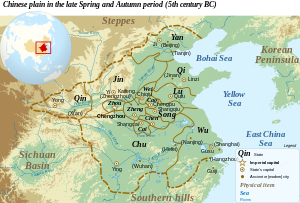
Lu can be seen in Cathay's northeast.
It is thought that Confucius was built-in on September 28, 551 BCE,[29] [thirty] in Zou ( 鄒 , in modern Shandong province).[30] [31] The area was notionally controlled by the kings of Zhou but finer independent nether the local lords of Lu, who ruled from the nearby city of Qufu. His father Kong He (or Shuliang He) was an elderly commandant of the local Lu garrison.[32] His beginnings traced back through the dukes of Song to the Shang dynasty which had preceded the Zhou.[33] [34] [35] [36] Traditional accounts of Confucius'southward life chronicle that Kong He'south grandpa had migrated the family from Song to Lu.[37]
Kong He died when Confucius was three years erstwhile, and Confucius was raised past his mother Yan Zhengzai ( 顏徵在 ) in poverty.[38] His mother later died at less than 40 years of age.[38] At age 19 he married Lady Qiguan ( 亓官氏 ), and a twelvemonth later the couple had their first child, their son Kong Li ( 孔鯉 ).[38] Qiguan and Confucius later had ii daughters together, 1 of whom is thought to have died as a child and one was named Kong Jiao ( 孔姣 ).[39]
Confucius was educated at schools for commoners, where he studied and learned the Half-dozen Arts.[40]
Confucius was born into the class of shi ( 士 ), between the aristocracy and the common people. He is said to have worked in various government jobs during his early 20s, and as a bookkeeper and a caretaker of sheep and horses, using the proceeds to requite his mother a proper burial.[38] [41] When his mother died, Confucius (aged 23) is said to have mourned for 3 years, every bit was the tradition.[41]
Political career
In Confucius'southward time, the land of Lu was headed past a ruling ducal house.[42] Nether the knuckles were iii aristocratic families, whose heads bore the title of viscount and held hereditary positions in the Lu bureaucracy.[43] The Ji family unit held the position "Government minister over the Masses", who was also the "Prime Government minister"; the Meng family held the position "Minister of Works"; and the Shu family held the position "Minister of War".[43] In the winter of 505BCE, Yang Hu—a retainer of the Ji family—rose up in rebellion and seized ability from the Ji family.[43] Yet, past the summer of 501BCE, the three hereditary families had succeeded in expelling Yang Hu from Lu.[43] By then, Confucius had built up a considerable reputation through his teachings, while the families came to see the value of proper conduct and righteousness, then they could achieve loyalty to a legitimate regime.[44] Thus, that twelvemonth (501BCE), Confucius came to be appointed to the small-scale position of governor of a town.[44] Eventually, he rose to the position of Government minister of Crime.[44]
Confucius desired to return the authority of the state to the duke by dismantling the fortifications of the city—strongholds belonging to the three families.[45] This way, he could constitute a centralized government.[45] However, Confucius relied solely on diplomacy equally he had no war machine authorisation himself.[45] In 500BCE, Hou Fan—the governor of Hou—revolted against his lord of the Shu family.[45] Although the Meng and Shu families unsuccessfully besieged Hou, a loyalist official rose upwardly with the people of Hou and forced Hou Fan to flee to the Qi state.[45] The state of affairs may take been in favor for Confucius as this likely made it possible for Confucius and his disciples to convince the aristocratic families to dismantle the fortifications of their cities.[45] Eventually, later on a year and a one-half, Confucius and his disciples succeeded in convincing the Shu family unit to raze the walls of Hou, the Ji family in razing the walls of Bi, and the Meng family in razing the walls of Cheng.[45] Kickoff, the Shu family led an army towards their metropolis Hou and tore downwards its walls in 498BCE.[45]

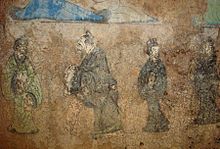
Soon thereafter, Gongshan Furao (also known equally Gongshan Buniu), a retainer of the Ji family, revolted and took control of the forces at Bi.[46] [47] He immediately launched an attack and entered the capital Lu.[45] Earlier, Gongshan had approached Confucius to bring together him, which Confucius considered equally he wanted the opportunity to put his principles into practice but he gave upward on the idea in the stop.[46] Confucius disapproved the use of a violent revolution past principle, even though the Ji family dominated the Lu state by force for generations and had exiled the previous knuckles.[46] Creel (1949) states that, dissimilar the rebel Yang Hu before him, Gongshan may have sought to destroy the three hereditary families and restore the power of the duke.[48] However, Dubs (1946) is of the view that Gongshan was encouraged by Viscount Ji Huan to invade the Lu capital in an attempt to avoid dismantling the Bi fortified walls.[47] Whatever the situation may have been, Gongshan was considered an upright man who continued to defend the state of Lu, fifty-fifty later he was forced to flee.[48] [49]
During the defection by Gongshan, Zhong You had managed to keep the duke and the iii viscounts together at the court.[49] Zhong You was one of the disciples of Confucius and Confucius had arranged for him to be given the position of governor by the Ji family.[fifty] When Confucius heard of the raid, he requested that Viscount Ji Huan permit the duke and his court to retreat to a stronghold on his palace grounds.[51] Thereafter, the heads of the iii families and the duke retreated to the Ji's palace complex and ascended the Wuzi Terrace.[52] Confucius ordered two officers to lead an assail confronting the rebels.[52] At least ane of the ii officers was a servant of the Ji family, only they were unable to reject the orders while in the presence of the duke, viscounts, and court.[51] The rebels were pursued and defeated at Gu.[52] Immediately after the defection was defeated, the Ji family razed the Bi city walls to the ground.[52]
The attackers retreated later realizing that they would have to become rebels against the land and their lord.[51] Through Confucius' actions, the Bi officials had inadvertently revolted against their ain lord, thus forcing Viscount Ji Huan'southward hand in having to dismantle the walls of Bi (as it could accept harbored such rebels) or confess to instigating the result by going confronting proper acquit and righteousness every bit an official.[51] Dubs (1949) suggests that the incident brought to light Confucius' foresight, practical political ability, and insight into human being character.[51]
When it was time to dismantle the urban center walls of the Meng family, the governor was reluctant to have his metropolis walls torn down and convinced the head of the Meng family non to do so.[52] The Zuozhuan recalls that the governor advised against razing the walls to the footing as he said that it made Cheng vulnerable to the Qi state and cause the destruction of the Meng family.[51] Even though Viscount Meng Yi gave his give-and-take not to interfere with an attempt, he went back on his earlier promise to dismantle the walls.[51]
Later in 498BCE, Duke Ding personally went with an army to lay siege to Cheng in an effort to raze its walls to the ground, but he did not succeed.[53] Thus, Confucius could not achieve the idealistic reforms that he wanted including restoration of the legitimate dominion of the duke.[54] He had fabricated powerful enemies within the country, particularly with Viscount Ji Huan, due to his successes so far.[55] According to accounts in the Zuozhuan and Shiji, Confucius departed his homeland in 497BCE subsequently his support for the failed attempt of dismantling the fortified metropolis walls of the powerful Ji, Meng, and Shu families.[56] He left the state of Lu without resigning, remaining in self-exile and unable to return as long every bit Viscount Ji Huan was alive.[55]
Exile

Map showing the journeying of Confucius to various states between 497 BCE and 484 BCE.
The Shiji stated that the neighboring Qi state was worried that Lu was becoming too powerful while Confucius was involved in the authorities of the Lu state. According to this account, Qi decided to demolition Lu'south reforms by sending 100 good horses and eighty beautiful dancing girls to the knuckles of Lu. The duke indulged himself in pleasure and did non attend to official duties for three days. Confucius was disappointed and resolved to exit Lu and seek amend opportunities, yet to leave at once would expose the misbehavior of the knuckles and therefore bring public humiliation to the ruler Confucius was serving. Confucius therefore waited for the duke to make a lesser fault. Shortly after, the duke neglected to send to Confucius a portion of the sacrificial meat that was his due according to custom, and Confucius seized upon this pretext to exit both his postal service and the Lu state.
Later on Confucius's resignation, he began a long journey or ready of journeys around the principality states of north-east and central Mainland china including Wey, Song, Zheng, Cao, Chu, Qi, Chen, and Cai (and a failed attempt to become to Jin). At the courts of these states, he expounded his political beliefs but did not run into them implemented.[ citation needed ]
Render home

Co-ordinate to the Zuozhuan, Confucius returned home to his native Lu when he was 68, later he was invited to do and so by Ji Kangzi, the principal minister of Lu.[57] The Analects describe him spending his last years teaching 72 or 77 disciples and transmitting the old wisdom via a prepare of texts chosen the Five Classics.[ citation needed ]
During his render, Confucius sometimes acted as an advisor to several government officials in Lu, including Ji Kangzi, on matters including governance and crime.[57]
Burdened by the loss of both his son and his favorite disciples, he died at the age of 71 or 72 from natural causes. Confucius was buried in Kong Lin cemetery which lies in the historical role of Qufu in the Shandong Province.[58] The original tomb erected there in retentivity of Confucius on the bank of the Sishui River had the shape of an axe. In addition, it has a raised brick platform at the front of the memorial for offerings such every bit sandalwood incense and fruit.[ citation needed ]
Philosophy

Although Confucianism is often followed in a religious manner by the Chinese, many debate that its values are secular and that it is, therefore, less a religion than a secular morality. Proponents fence, yet, that despite the secular nature of Confucianism'southward teachings, information technology is based on a worldview that is religious.[59] Confucianism discusses elements of the afterlife and views concerning Heaven, but it is relatively unconcerned with some spiritual matters often considered essential to religious thought, such as the nature of souls.[ citation needed ]
In the Analects, Confucius presents himself as a "transmitter who invented nil". He puts the greatest accent on the importance of written report, and it is the Chinese character for written report (學) that opens the text. Far from trying to build a systematic or formalist theory, he wanted his disciples to master and internalize older classics, then that their deep thought and thorough study would let them to relate the moral issues of the present to past political events (equally recorded in the Annals) or the past expressions of commoners' feelings and noblemen's reflections (as in the poems of the Book of Odes).[ citation needed ]
Ideals

One of the deepest teachings of Confucius may take been the superiority of personal exemplification over explicit rules of behavior. His moral teachings emphasized cocky-cultivation, emulation of moral exemplars, and the attainment of skilled judgment rather than knowledge of rules. Confucian ideals may, therefore, be considered a type of virtue ideals. His teachings rarely rely on reasoned argument, and ethical ideals and methods are conveyed indirectly, through allusion, innuendo, and even tautology. His teachings crave examination and context to be understood. A proficient instance is institute in this famous anecdote:
-
- 廄焚。子退朝,曰:傷人乎?不問馬。
- When the stables were burnt downward, on returning from courtroom Confucius said, "Was anyone injure?" He did not inquire about the horses.
-
-
-
-
- Analects X.11 (tr. Waley), 10–xiii (tr. Legge), or X-17 (tr. Lau)
-
-
-
-
By not asking almost the horses, Confucius demonstrates that the sage values human beings over holding (which animals seem to represent in this example); readers are led to reflect on whether their response would follow Confucius'southward and to pursue self-improvement if it would not have.[ commendation needed ]
Ane of his teachings was a variant of the Golden Rule, sometimes called the "Silver Rule" owing to its negative form:
-
- 己所不欲,勿施於人。
- "What you do non wish for yourself, exercise not do to others."[ citation needed ]
-
- 子貢問曰:有一言而可以終身行之者乎?子曰:其恕乎!己所不欲、勿施於人。
- Zi Gong [a disciple] asked: "Is in that location any one word that could guide a person throughout life?" The Chief replied: "How about 'reciprocity'! Never impose on others what yous would not cull for yourself."
-
-
-
-
- Analects XV.24, tr. David Hinton
-
-
-
-
Oftentimes disregarded in Confucian ethics are the virtues to the self: sincerity and the tillage of cognition. Virtuous action towards others begins with virtuous and sincere thought, which begins with knowledge. A virtuous disposition without cognition is susceptible to abuse, and virtuous activity without sincerity is not truthful righteousness. Cultivating knowledge and sincerity is also important for one's own sake; the superior person loves learning for the sake of learning and righteousness for the sake of righteousness..[ citation needed ]
The Confucian theory of ideals equally exemplified in lǐ ( 禮 ) is based on 3 important conceptual aspects of life: (a) ceremonies associated with sacrifice to ancestors and deities of various types, (b) social and political institutions, and (c) the etiquette of daily behavior. Some believed that lǐ originated from the heavens, only Confucius stressed the development of lǐ through the actions of sage leaders in man history. His discussions of lǐ seem to redefine the term to refer to all actions committed by a person to build the platonic society, rather than those simply conforming with canonical standards of ceremony.[ citation needed ]
In the early Confucian tradition, lǐ was doing the proper thing at the proper fourth dimension; balancing betwixt maintaining existing norms to perpetuate an upstanding social fabric, and violating them in order to accomplish ethical good. Preparation in the lǐ of by sages, cultivates virtues in people that include upstanding judgment virtually when lǐ must be adapted in light of situational contexts.
In Confucianism, the concept of li is closely related to yì ( 義 ), which is based upon the thought of reciprocity. Yì can exist translated as righteousness, though it may simply mean what is ethically best to practice in a certain context. The term contrasts with action done out of self-interest. While pursuing one'south ain self-involvement is not necessarily bad, one would exist a ameliorate, more righteous person if one'due south life was based upon following a path designed to enhance the greater adept. Thus an outcome of yì is doing the right thing for the right reason.[ citation needed ]
Just as action according to lǐ should exist adapted to conform to the aspiration of adhering to yì, so yì is linked to the cadre value of rén ( 仁 ).Rén consists of five bones virtues: seriousness, generosity, sincerity, diligence, and kindness.[60] Rén is the virtue of perfectly fulfilling i'south responsibilities toward others, most often translated as "benevolence" or "humaneness"; translator Arthur Waley calls it "Goodness" (with a capital Grand), and other translations that have been put forth include "authoritativeness" and "selflessness." Confucius'due south moral system was based upon empathy and understanding others, rather than divinely ordained rules. To develop one's spontaneous responses of rén and so that these could guide action intuitively was even amend than living by the rules of yì. Confucius asserts that virtue is a hateful between extremes. For example, the properly generous person gives the correct amount — not besides much and non too lilliputian.[60]
Politics
Confucius'due south political thought is based upon his ethical idea. He argued that the best government is one that rules through "rites" (lǐ) and people'south natural morality, and not by using bribery and coercion. He explained that this is ane of the near important analects: "If the people be led past laws, and uniformity sought to be given them by punishments, they will try to avoid the penalty, only have no sense of shame. If they be led past virtue, and uniformity sought to exist given them by the rules of propriety, they volition have the sense of the shame, and moreover will get good." (Translated by James Legge) in the Swell Learning ( 大學 ). This "sense of shame" is an internalisation of duty, where the penalisation precedes the evil action, instead of post-obit information technology in the form of laws equally in Legalism.[ citation needed ]
Confucius looked nostalgically upon earlier days, and urged the Chinese, especially those with political power, to model themselves on earlier examples. In times of division, chaos, and endless wars between feudal states, he wanted to restore the Mandate of Heaven ( 天命 ) that could unify the "world" ( 天下 , "all under Heaven") and bestow peace and prosperity on the people. Because his vision of personal and social perfections was framed as a revival of the ordered club of earlier times, Confucius is often considered a great proponent of conservatism, but a closer look at what he proposes often shows that he used (and perhaps twisted) past institutions and rites to push a new political agenda of his own: a revival of a unified royal state, whose rulers would succeed to power on the basis of their moral merits instead of lineage. These would be rulers devoted to their people, striving for personal and social perfection, and such a ruler would spread his ain virtues to the people instead of imposing proper behavior with laws and rules.[ citation needed ]
While Conficius supported the idea of government ruling by a virtuous king, his ideas independent a number of elements to limit the power of rulers. He argued for representing truth in language, and honesty was of paramount importance. Even in facial expression, truth must always be represented..[ citation needed ] Confucius believed that if a ruler is to lead correctly, by activity, that orders would be unnecessary in that others will follow the proper actions of their ruler. In discussing the relationship between a rex and his subject (or a father and his son), he underlined the need to requite due respect to superiors. This demanded that the subordinates must advise their superiors if the superiors are considered to be taking a course of activity that is wrong. Confucius believed in ruling by example, if you lead correctly, orders by force or punishment are not necessary.[61]
Music and Poetry

Confucius heavily promoted the employ of music with rituals or the rites gild. The scholar Li Zehou argued that Confucianism is based on the idea of rites. Rites serve as the starting signal for each individual and that these sacred social functions let each person's human nature to exist harmonious with reality. Given this, Confucius believed that "music is the harmonization of heaven and earth; the rites is the order of heaven and earth." Thus the application of music in rites creates the guild that makes it possible for lodge to prosper.[1]
The Confucian approach to music was heavily inspired by the Shijing and the Classic of Music, which was said to be the sixth Confucian classic until it was lost during the Han Dynasty. The Shijing serves as one of the electric current Confucian classics and is a book on poetry that contains a diversified variety of poems likewise as folk songs. Confucius is traditionally ascribed with compiling these classics inside his school.[62] In the Analects, Confucius described the importance of the art in the development of guild: [63]
"The Master said, 'My children, why do you not study the Book of Poetry?
'The Odes serve to stimulate the heed. 'They may be used for purposes of self-contemplation. 'They teach the art of sociability. 'They show how to regulate feelings of resentment. 'From them you acquire the more immediate duty of serving one'southward father, and the remoter one of serving ane'south prince.
'From them we go largely acquainted with the names of birds, beasts, and plants.'"[ citation needed ]
Legacy

Confucius'southward teachings were later turned into an elaborate set of rules and practices past his numerous disciples and followers, who organized his teachings into the Analects.[64] [65] Confucius's disciples and his but grandson, Zisi, continued his philosophical school after his death.[66] These efforts spread Confucian ethics to students who and then became officials in many of the royal courts in People's republic of china, thereby giving Confucianism the first wide-scale test of its dogma.[ citation needed ]
Two of Confucius'due south virtually famous after followers emphasized radically different aspects of his teachings. In the centuries later on his death, Mencius ( 孟子 ) and Xun Zi ( 荀子 ) both composed of import teachings elaborating in different ways on the central ideas associated with Confucius. Mencius (4th centuryBCE) articulated the innate goodness in human being beings equally a source of the upstanding intuitions that guide people towards rén, yì, and lǐ, while Xun Zi (3rd centuryBCE) underscored the realistic and materialistic aspects of Confucian idea, stressing that morality was inculcated in gild through tradition and in individuals through training. In time, their writings, together with the Analects and other cadre texts came to plant the philosophical corpus of Confucianism..[ citation needed ]
This realignment in Confucian thought was parallel to the development of Legalism, which saw filial piety as cocky-interest and not a useful tool for a ruler to create an constructive country.[ commendation needed ] A disagreement between these two political philosophies came to a head in 223BCE when the Qin state conquered all of Red china. Li Si, Prime Minister of the Qin dynasty, convinced Qin Shi Huang to abandon the Confucians' recommendation of awarding fiefs alike to the Zhou Dynasty before them which he saw equally being confronting to the Legalist idea of centralizing the country around the ruler. When the Confucian directorate pressed their point, Li Si had many Confucian scholars killed and their books burned—considered a huge blow to the philosophy and Chinese scholarship.[ citation needed ]
Under the succeeding Han and Tang dynasties, Confucian ideas gained even more widespread prominence. Nether Wudi, the works of Confucius were fabricated the official imperial philosophy and required reading for ceremonious service examinations in 140BCE which was continued well-nigh unbroken until the end of the 19th century. As Mohism lost support by the fourth dimension of the Han, the main philosophical contenders were Legalism, which Confucian thought somewhat absorbed, the teachings of Laozi, whose focus on more spiritual ideas kept it from direct conflict with Confucianism, and the new Buddhist religion, which gained acceptance during the Southern and Northern Dynasties era. Both Confucian ideas and Confucian-trained officials were relied upon in the Ming Dynasty and even the Yuan Dynasty, although Kublai Khan distrusted handing over provincial control to them.[ commendation needed ]
During the Song dynasty, the scholar Zhu Xi (1130–1200CE) added ideas from Daoism and Buddhism into Confucianism. In his life, Zhu Xi was largely ignored, simply not long after his death, his ideas became the new orthodox view of what Confucian texts really meant. Mod historians view Zhu Xi as having created something rather unlike and call his way of thinking Neo-Confucianism. Neo-Confucianism held sway in Communist china, Japan, Korea, and Vietnam until the 19th century..[ citation needed ]
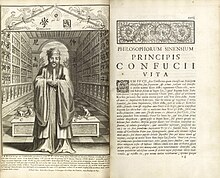
The works of Confucius were offset translated into European languages by Jesuit missionaries in the 16th century during the late Ming dynasty. The first known effort was by Michele Ruggieri, who returned to Italy in 1588 and carried on his translations while residing in Salerno. Matteo Ricci started to written report on the thoughts of Confucius, and a team of Jesuits—Prospero Intorcetta, Philippe Couplet, and two others—published a translation of several Confucian works and an overview of Chinese history in Paris in 1687.[67] [68] François Noël, after failing to persuade Cloudless11 that Chinese veneration of ancestors and Confucius did not establish idolatry, completed the Confucian canon at Prague in 1711, with more than scholarly treatments of the other works and the get-go translation of the collected works of Mencius.[69] It is thought that such works had considerable importance on European thinkers of the period, especially among the Deists and other philosophical groups of the Enlightenment who were interested past the integration of the system of morality of Confucius into Western civilization.[68] [70]
In the mod era Confucian movements, such as New Confucianism, still exist, but during the Cultural Revolution, Confucianism was oft attacked by leading figures in the Chinese Communist Party. This was partially a continuation of the condemnations of Confucianism by intellectuals and activists in the early 20th century as a cause of the ethnocentric close-mindedness and refusal of the Qing Dynasty to modernize that led to the tragedies that befell China in the 19th century..[ citation needed ]
Confucius's works are studied by scholars in many other Asian countries, particularly those in the Chinese cultural sphere, such as Korea, Japan, and Vietnam. Many of those countries notwithstanding hold the traditional memorial ceremony every yr.[ commendation needed ]
Among Tibetans, Confucius is oftentimes worshipped equally a holy male monarch and master of magic, divination and star divination. Tibetan Buddhists see him as learning divination from the Buddha Manjushri (and that cognition afterward reaching Tibet through Princess Wencheng), while Bon practitioners see him as existence a reincarnation of Tonpa Shenrab Miwoche, the legendary founder of Bon.[71]
The Ahmadiyya Muslim Customs believes Confucius was a Divine Prophet of God, as were Lao-Tzu and other eminent Chinese personages.[72]
In modern times, Asteroid 7853, "Confucius", was named subsequently the Chinese thinker.[73]
Disciples

Confucius began instruction after he turned 30, and taught more than than 3,000 students in his life, about 70 of whom were considered outstanding. His disciples and the early Confucian community they formed became the nigh influential intellectual forcefulness in the Warring States menses.[74] The Han dynasty historian Sima Qian dedicated a chapter in his Records of the Thousand Historian to the biographies of Confucius'due south disciples, accounting for the influence they exerted in their time and afterward. Sima Qian recorded the names of 77 disciples in his collective biography, while Kongzi Jiayu, another early source, records 76, not completely overlapping. The 2 sources together yield the names of 96 disciples.[75] 22 of them are mentioned in the Analects, while the Mencius records 24.[76]
Confucius did not accuse any tuition, and just requested a symbolic gift of a bundle of dried meat from whatsoever prospective student. According to his disciple Zigong, his master treated students like doctors treated patients and did non turn anybody abroad.[75] Most of them came from Lu, Confucius's home state, with 43 recorded, but he accepted students from all over Cathay, with 6 from the land of Wey (such as Zigong), 3 from Qin, two each from Chen and Qi, and 1 each from Cai, Chu, and Song.[75] Confucius considered his students' personal groundwork irrelevant, and accepted noblemen, commoners, and even former criminals such equally Yan Zhuoju and Gongye Chang.[77] His disciples from richer families would pay a sum commensurate with their wealth which was considered a ritual donation.[75]
Confucius's favorite disciple was Yan Hui, most probably ane of the most impoverished of them all.[76] Sima Niu, in contrast to Yan Hui, was from a hereditary noble family hailing from the Vocal land.[76] Nether Confucius's teachings, the disciples became well-learned in the principles and methods of government.[78] He often engaged in discussion and contend with his students and gave high importance to their studies in history, poetry, and ritual.[78] Confucius advocated loyalty to principle rather than to individual apprehending, in which reform was to be achieved by persuasion rather than violence.[78] Even though Confucius denounced them for their practices, the elite was likely attracted to the idea of having trustworthy officials who were studied in morals as the circumstances of the fourth dimension made it desirable.[78] In fact, the disciple Zilu even died defending his ruler in Wey.[78]
Yang Hu, who was a subordinate of the Ji family unit, had dominated the Lu authorities from 505 to 502 and fifty-fifty attempted a insurrection, which narrowly failed.[78] As a likely effect, information technology was after this that the offset disciples of Confucius were appointed to government positions.[78] A few of Confucius's disciples went on to accomplish official positions of some importance, some of which were arranged past Confucius.[79] By the time Confucius was 50 years old, the Ji family unit had consolidated their power in the Lu country over the ruling ducal house.[fourscore] Even though the Ji family had practices with which Confucius disagreed and disapproved, they notwithstanding gave Confucius'due south disciples many opportunities for employment.[80] Confucius connected to remind his disciples to stay true to their principles and renounced those who did not, all the while being openly critical of the Ji family unit.[81]
Visual portraits
No gimmicky painting or sculpture of Confucius survives, and it was only during the Han Dynasty that he was portrayed visually. Carvings often depict his legendary meeting with Laozi. Since that time there have been many portraits of Confucius as the ideal philosopher. The oldest known portrait of Confucius has been unearthed in the tomb of the Han dynasty ruler Marquis of Haihun (died 59BCE). The picture was painted on the wooden frame to a polished bronze mirror.[82]
In one-time times, it was customary to take a portrait in Confucius Temples; still, during the reign of Hongwu Emperor (Taizu) of the Ming dynasty, it was decided that the merely proper portrait of Confucius should exist in the temple in his home town, Qufu in Shandong. In other temples, Confucius is represented by a memorial tablet. In 2006, the People's republic of china Confucius Foundation commissioned a standard portrait of Confucius based on the Tang dynasty portrait by Wu Daozi.
The South Wall Frieze in the courtroom of the Supreme Court of the United states of america depicts Confucius as a teacher of harmony, learning, and virtue.[83]
Fictional portrayals
There have been two film adaptations of Confucius' life: Confucius (1940) starring Tang Huaiqiu, and Confucius (2010) starring Chow Yun-fat.[ citation needed ]
In music, Tori Amos imagines Confucius equally working on a crossword puzzle in her 1992 song "Happy Phantom."[ commendation needed ]
Memorials


Soon afterwards Confucius'southward death, Qufu, his dwelling house town, became a place of devotion and remembrance. The Han dynasty Records of the One thousand Historian records that it had already become a place of pilgrimage for ministers. It is still a major destination for cultural tourism, and many people visit his grave and the surrounding temples. In Sinic cultures, there are many temples where representations of the Buddha, Laozi, and Confucius are found together. There are also many temples dedicated to him, which have been used for Confucian ceremonies.[ citation needed ]
Followers of Confucianism take a tradition of holding spectacular memorial ceremonies of Confucius ( 祭孔 ) every yr, using ceremonies that supposedly derived from Zhou Li ( 周禮 ) as recorded by Confucius, on the date of Confucius'due south nascency. In the 20th century, this tradition was interrupted for several decades in mainland Communist china, where the official opinion of the Communist Party and the State was that Confucius and Confucianism represented reactionary feudalist beliefs which held that the subservience of the people to the aristocracy is a role of the natural order. All such ceremonies and rites were therefore banned. Only after the 1990s did the ceremony resume. As information technology is now considered a veneration of Chinese history and tradition, even Communist Party members may be constitute in attendance.[ commendation needed ]
In Taiwan, where the Nationalist Political party (Kuomintang) strongly promoted Confucian beliefs in ideals and beliefs, the tradition of the memorial ceremony of Confucius ( 祭孔 ) is supported past the authorities and has continued without pause. While non a national holiday, information technology does appear on all printed calendars, much equally Father'southward Mean solar day or Christmas Day practise in the Western world.[ commendation needed ]
In South Korea, a 1000-scale memorial ceremony called Seokjeon Daeje is held twice a year on Confucius'south altogether and the anniversary of his death, at Confucian academies across the country and Sungkyunkwan in Seoul.[ citation needed ]
Descendants
Confucius'southward descendants were repeatedly identified and honored by successive regal governments with titles of nobility and official posts. They were honored with the rank of a marquis 35 times since Gaozu of the Han dynasty, and they were promoted to the rank of duke 42 times from the Tang dynasty to the Qing dynasty. Emperor Xuanzong of Tang starting time bestowed the title of "Duke Wenxuan" on Kong Suizhi of the 35th generation. In 1055, Emperor Renzong of Vocal first bestowed the title of "Duke Yansheng" on Kong Zongyuan of the 46th generation.[ commendation needed ]
During the Southern Vocal dynasty, the Duke Yansheng Kong Duanyou fled south with the Vocal Emperor to Quzhou in Zhejiang, while the newly established Jin dynasty (1115–1234) in the north appointed Kong Duanyou's brother Kong Duancao who remained in Qufu every bit Knuckles Yansheng.[84] [85] [86] [87] [88] [89] [90] [91] [92] From that time up until the Yuan dynasty, in that location were two Knuckles Yanshengs, 1 in the north in Qufu and the other in the s at Quzhou. An invitation to come back to Qufu was extended to the southern Duke Yansheng Kong Zhu by the Yuan-dynasty Emperor Kublai Khan. The title was taken away from the southern branch later on Kong Zhu rejected the invitation,[93] so the northern co-operative of the family kept the title of Duke Yansheng. The southern branch remained in Quzhou where they live to this twenty-four hour period. Confucius's descendants in Quzhou lonely number 30,000.[94] [ unreliable source? ] The Hanlin Academy rank of Wujing boshi 五經博士 was awarded to the southern branch at Quzhou by a Ming Emperor while the northern branch at Qufu held the championship Duke Yansheng.[95] [96] The leader of the southern branch is 孔祥楷 Kong Xiangkai.[97]
In 1351, during the reign of Emperor Toghon Temür of the Yuan dynasty, 53rd-generation descendant Kong Huan ( 孔浣 )'due south 2nd son Kong Shao ( 孔昭 ) moved from China to Korea during the Goryeo Dynasty, and was received courteously by Princess Noguk (the Mongolian-born wife of the future king Gongmin). Later being naturalized as a Korean denizen, he changed the hanja of his proper noun from "昭" to "紹" (both pronounced so in Korean),[98] married a Korean woman and diameter a son (Gong Yeo (Korean: 공여 ; Hanja: 孔帤 ), 1329–1397), therefore establishing the Changwon Gong association (Korean: 창원 공씨 ; Hanja: 昌原 孔氏 ), whose ancestral seat was located in Changwon, South Gyeongsang Province. The clan then received an aloof rank during the succeeding Joseon Dynasty.[99] [100] [101] [102] [103] In 1794, during the reign of King Jeongjo, the clan then changed its proper name to Gokbu Gong association (Korean: 곡부 공씨 ; Hanja: 曲阜 孔氏 ) in honor of Confucius's birthplace Qufu (Korean: 곡부 ; Hanja: 曲阜 ; RR: Gokbu ).[104]
Famous descendants include actors such every bit Gong Yoo (real name Gong Ji-cheol (공지철)) & Gong Hyo-jin (공효진); and artists such as male idol group B1A4 member Gongchan (real proper noun Gong Chan-sik (공찬식)), vocalist-songwriter Minzy (existent name Gong Min-ji (공민지)), besides as her great-aunt traditional folk dancer Gong Ok-jin (공옥진).
Despite repeated dynastic modify in Communist china, the championship of Duke Yansheng was bestowed upon successive generations of descendants until it was abolished by the Nationalist Authorities in 1935. The last holder of the title, Kung Te-cheng of the 77th generation, was appointed Sacrificial Official to Confucius. Kung Te-cheng died in Oct 2008, and his son, Kung Wei-yi, the 78th lineal descendant, had died in 1989. Kung Te-cheng'due south grandson, Kung Tsui-chang, the 79th lineal descendant, was born in 1975; his great-grandson, Kung Yu-jen, the 80th lineal descendant, was built-in in Taipei on January 1, 2006. Te-cheng's sister, Kong Demao, lives in mainland China and has written a book nearly her experiences growing upward at the family estate in Qufu. Another sister, Kong Deqi, died every bit a young adult female.[105] Many descendants of Confucius still live in Qufu today.
A descendant of Confucius, H. H. Kung was the Premier of the Republic of China. One of his sons, Kong Lingjie 孔令傑 married Debra Paget[106] who gave birth to Gregory Kung ( 孔德基 ).
Confucius's family unit, the Kongs, accept the longest recorded extant pedigree in the globe today. The male parent-to-son family tree, at present in its 83rd generation,[107] has been recorded since the expiry of Confucius. Co-ordinate to the Confucius Genealogy Compilation Committee (CGCC), he has two million known and registered descendants, and in that location are an estimated three million in all.[108] Of these, several tens of thousands live outside of China.[108] In the 14th century, a Kong descendant went to Korea, where an estimated 34,000 descendants of Confucius live today.[108] One of the main lineages fled from the Kong ancestral domicile in Qufu during the Chinese Ceremonious War in the 1940s and eventually settled in Taiwan.[105] There are besides branches of the Kong family who have converted to Islam after marrying Muslim women, in Dachuan in Gansu province in the 1800s,[109] and in 1715 in Xuanwei in Yunnan province.[110] Many of the Muslim Confucius descendants are descended from the matrimony of Ma Jiaga ( 馬甲尕 ), a Muslim woman, and Kong Yanrong ( 孔彥嶸 ), 59th generation descendant of Confucius in the year 1480 and are found amongst the Hui and Dongxiang peoples.[111] [112] [113] [114] The new genealogy includes the Muslims.[115] Kong Dejun ( 孔德軍 ) is a prominent Islamic scholar and Arabist from Qinghai province and a 77th generation descendant of Confucius.
Because of the huge interest in the Confucius family tree, there was a project in Prc to test the Deoxyribonucleic acid of known family members of the collateral branches in mainland China.[116] Amongst other things, this would allow scientists to place a common Y chromosome in male person descendants of Confucius. If the descent were truly unbroken, begetter-to-son, since Confucius's lifetime, the males in the family would all take the same Y chromosome as their directly male person antecedent, with slight mutations due to the passage of time.[117] The aim of the genetic test was to help members of collateral branches in Cathay who lost their genealogical records to prove their descent. Yet, in 2009, many of the collateral branches decided not to agree to DNA testing.[118] Bryan Sykes, professor of genetics at Oxford Academy, understands this decision: "The Confucius family unit tree has an enormous cultural significance," he said. "Information technology'south not just a scientific question."[118] The DNA testing was originally proposed to add together new members, many of whose family tape books were lost during 20th-century upheavals, to the Confucian family tree.[119] The principal branch of the family which fled to Taiwan was never involved in the proposed DNA exam at all.
In 2013 a DNA exam performed on multiple different families who claimed descent from Confucius institute that they shared the same Y chromosome every bit reported by Fudan University.[120]
The fifth and most contempo edition of the Confucius genealogy was printed by the CGCC.[121] It was unveiled in a ceremony at Qufu on September 24, 2009.[121] Women are at present included for the beginning time.[122]
References
Citations
- ^ a b Kirkendall, Jensen Armstrong (2017-12-14). "The Well-Ordered Middle: Confucius on Harmony, Music, and Ritual" (PDF). Archived (PDF) from the original on 2021-04-xiii. Retrieved 2021-04-thirteen .
- ^ Cai, Zong-qi (July 1999). "In Quest of Harmony: Plato and Confucius on Poetry". Philosophy East and West. 49 (three): 317–345. doi:10.2307/1399898. JSTOR 1399898. Archived from the original on 2021-06-01. Retrieved 2021-04-13 .
- ^ Fung 2008, p. 163.
- ^ Allinson, Robert E. (December 1998). "Complementarity as a Model for Eastwest Integrative Philosophy".
- ^ Christianity and Confucianism: Culture, Faith and Politics. London, United Kingdom: Bloombsbury Publishing. 2020. p. 382. ISBN9780567657688. Archived from the original on 2021-08-09. Retrieved 2021-05-03 .
- ^ Holton, Gerald (June 1986). "Niels Bohr and the Integrity of Science: Integrity in science involves not just the avoidance of dishonorable behavior but besides some principles of action that are exemplified in the life and work of Niels Bohr". American Scientist. 74 (3): 237–243. JSTOR 27854096. Archived from the original on 2021-08-09. Retrieved 2021-04-12 .
- ^ Wang, Dave. "Benjamin Franklin and China" (PDF). Archived (PDF) from the original on 2021-04-11. Retrieved 2021-04-11 .
- ^ Hornung, Alfred (November 2018). "Confucius and Benjamin Franklin: Chinese Ideas in the Foundation of the United States". Archived from the original on 2021-04-11. Retrieved 2021-04-xi . }
- ^ "Confucius and Benjamin Franklin" (PDF). 2017-04-28. Archived (PDF) from the original on 2021-07-25. Retrieved 2021-04-eleven .
- ^ "Ginsberg and China". 9 September 2017. Archived from the original on 12 April 2021. Retrieved 12 April 2021.
- ^ Jackson, Brian (September 2010). "Modernist Looking: Surreal Impressions in the Poesy of Allen Ginsberg". Texas Studies in Literature and Language. 52 (three): 298–323. doi:10.1353/tsl.2010.0003. JSTOR 40928069. S2CID 162063608. Archived from the original on 2021-08-09. Retrieved 2021-04-12 .
- ^ Chan, Tsz Shan (January 2011). "Visions of Enlightenment: Aspects of Buddhism in Jack Kerouac, Allen Ginsberg and Gary Snyder" (PDF). Archived from the original (PDF) on 2021-04-12. Retrieved 2021-04-12 .
- ^ Burstein, Andrew (October 2007). "Review: Jefferson in Confucian Relief". JSTOR 25096753. Archived from the original on 2021-08-09. Retrieved 2021-04-12 .
- ^ "Confucius influenced America's founding fathers: scholar". 2017-09-26. Archived from the original on 2021-08-09. Retrieved 2021-04-12 .
- ^ Thompson, Kirill (October 2015). "Traditional Chinese Concepts and 17th–18th Century Enlightenment Ethics: Reflections on the IHS Conference on Freedom, Equality, Democracy, and the Rise of Marketplace Economic system, Oct 2015". Archived from the original on 2021-04-12. Retrieved 2021-01-01 .
- ^ Warburton, William (1779). "The works of Alexander Pope ... With notes by Dr. Warburton, and ilustrations on steel past eminent artists. From designs by Weigall, Heath, & others". Archived from the original on 2022-01-21. Retrieved 2021-04-11 .
- ^ Feng, Dong (Dec 2008). "The Great Harmony: An Essay on Man and Confucianism" (PDF). Archived (PDF) from the original on 2021-04-xi. Retrieved 2021-04-eleven .
- ^ Danton, George (November 1943). "Schiller and Confucius". The German Quarterly. xvi (4): 173–182. doi:10.2307/400763. JSTOR 400763. Archived from the original on 2021-08-09. Retrieved 2021-04-12 .
- ^ Schiller, Friedrich (2010-11-eighteen). "Proverbs of Confucius". The Open up Court. 1905 (five). Archived from the original on 2021-04-12. Retrieved 2021-04-12 .
- ^ Von Schiller, Johann Christian Friedrich. "Proverbs of Confucius". [ permanent expressionless link ]
- ^ "China, the Confucian Platonic, and the European Historic period of Enlightenment" (PDF). December 1983. Archived (PDF) from the original on 2021-04-10. Retrieved 2021-04-10 .
- ^ Rowbotham, Arnold H. (Dec 1932). "Voltaire, Sinophile". PMLA. 47 (4): 1050–1065. JSTOR 457929. Archived from the original on 2021-05-03. Retrieved 2021-04-10 .
- ^ Bailey, Paul (2002-07-nineteen). "Voltaire and Confucius: French attitudes towards People's republic of china in the early on twentieth century". History of European Ideas. 14 (6): 817–837. doi:10.1016/0191-6599(92)90168-C. Archived from the original on 2021-04-10. Retrieved 2021-04-x .
- ^ "The Life and Significance of Confucius". www.sjsu.edu. Archived from the original on 2019-12-27. Retrieved 2017-09-27 .
- ^ "Confucianism". Globe History Encyclopedia. Archived from the original on 2021-04-17. Retrieved 2020-xi-04 .
- ^ a b Nivison 1999, p. 752.
- ^ Hunter 2017, p. 50.
- ^ Wilkinson 2015, p. 133.
- ^ Hugan, Yong (2013). Confucius: A Guide for the Perplexed. A&C Black. p. 3. ISBN978-1-4411-9653-8. Archived from the original on 2017-04-sixteen.
- ^ a b Creel 1949, p. 25.
- ^ Rainey 2010, p. sixteen.
- ^ Legge 1887, p. 260.
- ^ Legge 1887, p. 259.
- ^ Yao 1997, p. 29.
- ^ Yao 2000, p. 23.
- ^ Rainey 2010, p. 66.
- ^ Creel 1949, p. 26.
- ^ a b c d Huang, Yong (2013). Confucius: A Guide for the Perplexed. A&C Black. p. 4. ISBN978-ane-4411-9653-8. Archived from the original on Apr 19, 2021. Retrieved August 12, 2015.
- ^ Schuman, Michael (2015). Confucius: And the World He Created. Bones Books. ISBN978-0-465-04057-5. Archived from the original on 2017-04-sixteen.
- ^ Huang, Yong (2013). Confucius: A Guide for the Perplexed. A&C Black. pp. four–5. ISBN978-ane-4411-9653-8. Archived from the original on 2017-04-16.
- ^ a b Burgan, Michael (2008). Confucius: Chinese Philosopher and Teacher. Capstone. p. 23. ISBN978-0-7565-3832-3. Archived from the original on April 16, 2017. Retrieved August 12, 2015.
- ^ Dubs 1946, pp. 274–275.
- ^ a b c d Dubs 1946, p. 275.
- ^ a b c Dubs 1946, pp. 275–276.
- ^ a b c d e f g h i Dubs 1946, p. 277.
- ^ a b c Creel 1949, pp. 35–36.
- ^ a b Dubs 1946, pp. 277–278.
- ^ a b Creel 1949, p. 35.
- ^ a b Dubs 1946, p. 278.
- ^ Dubs 1946, pp. 278–279.
- ^ a b c d e f g Dubs 1946, p. 279.
- ^ a b c d e Mentum 2007, 30.
- ^ Dubs 1946, p. 280.
- ^ Dubs 1946, pp. 280–281.
- ^ a b Dubs 1946, 281.
- ^ Riegel 1986, p. 13.
- ^ a b Huang, Yong (2013). Confucius: A Guide for the Perplexed. A&C Black. pp. 27–28. ISBN978-ane-4411-9653-viii. Archived from the original on June five, 2021. Retrieved August 13, 2015.
- ^ Centre, UNESCO Earth Heritage. "Temple and Cemetery of Confucius and the Kong Family Mansion in Qufu". UNESCO World Heritage Centre. Archived from the original on 2019-11-19. Retrieved 2019-11-25 .
- ^ Berger, Peter (February 15, 2012). "Is Confucianism a Faith?". The American Interest. Archived from the original on Baronial 17, 2015. Retrieved Baronial 13, 2015.
- ^ a b Bonevac & Phillips 2009, twoscore.
- ^ Violatti, Cristian (August 31, 2013). "Confucianism". Earth History Encyclopedia. Archived from the original on August eighteen, 2015. Retrieved Baronial 17, 2015.
- ^ Davis, Albert Richard, ed. (1970), The Penguin Volume of Chinese Verse, Baltimore: Penguin Books
- ^ "Confucius, The Analects - 17". 1901-12-13. Archived from the original on 2021-04-xiii. Retrieved 2021-04-xiii .
- ^ Knechtges & Shih 2010, p. 645.
- ^ Kim & Csikszentmihalyi 2010, p. 25.
- ^ Ames, Roger T. and David L. Hall (2001). Focusing the Familiar: A Translation and Philosophical Interpretation of the Zhongyong. University of Hawaii Press. p. 132. ISBN978-0-8248-2460-0.
- ^ Intorcetta, Prospero; et al., eds. (1687), Confucius Sinarum Philosophus, sive, Scientia Sinensis Latine Exposita [Confucius, Philosopher of the Chinese, or, Chinese Knowledge Explained in Latin] , Paris: Daniel Horthemels . (in Latin)
- ^ a b Parker 1977, 25.
- ^ Noël, François, ed. (1711), Sinensis Imperii Libri Classici Sex [The Half-dozen Archetype Books of the Chinese Empire] , Prague: Charles-Ferdinand Academy Printing, archived from the original on 2020-07-14, retrieved 2020-05-thirteen . (in Latin)
- ^ Hobson 2004, pp. 194–195.
- ^ Lin, Shen-yu (2005). "The Tibetan Paradigm of Confucius" (PDF). Revue d'Études Tibétaines (12): 105–129. Archived from the original (PDF) on xiii September 2017.
- ^ Ahmad n.d., online.
- ^ IAU Minor Planet Center Archived 2022-01-21 at the Wayback Auto. International Astronomical Union Minor Planet Center. Accessed 12 September 2018.
- ^ Shen 2013, p. 86.
- ^ a b c d Shen 2013, p. 87.
- ^ a b c Creel 1949, p. 30.
- ^ Shen 2013, p. 88.
- ^ a b c d e f g Creel 1949, p. 32.
- ^ Creel 1949, p. 31.
- ^ a b Creel 1949, p. 33.
- ^ Creel 1949, pp. 32–33.
- ^ "Confucius depicted on mirror". The Institute of Archaeology, Chinese Academy of Social Sciences. Archived from the original on 22 Feb 2017. Retrieved 22 Feb 2017.
- ^ "US Supreme Court Courtroom Friezes" (PDF). Archived (PDF) from the original on 13 July 2019. Retrieved 19 Feb 2019.
- ^ "Descendants and Portraits of Confucius in the Early Southern Song" (PDF). Archived from the original (PDF) on 2016-09-thirteen. Retrieved 2016-05-03 .
- ^ Banning, B. Paul. "AAS Abstracts: China Session 45". aas2.asian-studies.org. Archived from the original on 2016-10-06.
- ^ "AAS Abstracts: China Session 45: On Sacred Grounds: The Material Culture and Ritual Formation of the Confucian Temple in Late Imperial People's republic of china". Association for Asian Studies. Archived from the original on 2015-03-18. Retrieved 2014-08-05 .
- ^ "The Ritual Formation of Confucian Orthodoxy and the Descendants of the Sage (PDF Download Bachelor)". ResearchGate. Archived from the original on 2018-10-25. Retrieved 2016-05-03 .
- ^ Wilson, Thomas A. "Cult of Confucius". academics.hamilton.edu. Archived from the original on 2016-03-xviii. Retrieved 2016-05-03 .
- ^ "Quzhou Metropolis Guides – China TEFL Network". en.chinatefl.com. Archived from the original on 2016-03-04.
- ^ "confucianism". kfz.freehostingguru.com. Archived from the original on 2016-03-xiii.
- ^ "Confucius Anniversary Historic". www.prc.org.cn. Archived from the original on 2015-09-14.
- ^ "Archived re-create". Archived from the original on 2016-06-ten. Retrieved 2016-05-03 .
{{cite web}}: CS1 maint: archived copy as title (link) - ^ Jansen, Klein & Meyer 2014, pp. 187–188.
- ^ "Confucius Anniversary Celebrated". Red china Daily. September 29, 2006. Archived from the original on September fourteen, 2015.
- ^ Thomas A. Wilson (2002). On Sacred Grounds: Culture, Society, Politics, and the Formation of the Cult of Confucius. Harvard Academy Asia Heart. pp. 69, 315. ISBN978-0-674-00961-five. Archived from the original on 2021-08-09. Retrieved 2016-04-21 .
- ^ Jansen, Klein & Meyer 2014, p. 188.
- ^ Jansen, Klein & Meyer 2014, p. 189.
- ^ Due to a naming taboo regarding the birth name of the fourth king of Goryeo Gwangjong, built-in "Wang So" (Korean: 왕소 ; Hanja: 王昭 ).
- ^ "Descendants of Confucius in South korea Seek Roots in Quzhou". Quzhou.China. 2014-05-19. Archived from the original on 2015-02-04. Retrieved February 4, 2015.
- ^ "Republic of korea home to 80,000 descendants of Confucius – People's Daily Online". en.people.cn. Archived from the original on 2016-08-28.
- ^ "New Confucius Genealogy out next yr". www.prc.org.cn. Archived from the original on 2016-10-x.
- ^ "China Exclusive: Korean Confucius descendants trace back to ancestor of family tree". world wide web.china.org.cn. Archived from the original on 2016-06-01.
- ^ "Communist china Sectional: Korean Confucius descendants trace back to antecedent of family tree". www.news.xinhuanet.com. Archived from the original on 2016-07-29.
- ^ Doosan Encyclopedia 공 孔. Doosan Encyclopedia. Archived from the original on 2022-01-21. Retrieved 2017-10-twenty .
- ^ a b Kong, Ke & Roberts 1988.[ page needed ]
- ^ Bacon, James (Apr 21, 1962). "Debra Paget Weds Oilman, Nephew of Madame Chiang". Independent. p. 11. Archived from the original on June 13, 2015. Retrieved June xi, 2015 – via Newspapers.com.

- ^ China Economical Internet 2009, online.
- ^ a b c Yan 2008, online.
- ^ Jing, Jun (1998). The Temple of Memories: History, Power, and Morality in a Chinese Village. Stanford University Press. p. 26. ISBN978-0-8047-6492-six. Archived from the original on 2015-x-17.
- ^ Zhou, Jing. "New Confucius Genealogy out side by side year". red china.org.cn. Archived from the original on 2016-10-x. Retrieved 2010-06-28 .
- ^ "孔子后裔中有14个少数民族 有宗教信仰也传承家风 – 文化 – 人民网". culture.people.com.cn. Archived from the original on 2016-08-19.
- ^ 李典典. "孔子後裔有14個少數民族 外籍後裔首次入家譜_台灣網". big5.taiwan.cn. Archived from the original on 2016-10-06.
- ^ "西北生活着孔子回族后裔 – 文化 – 人民网". culture.people.com.cn. Archived from the original on 2016-04-09.
- ^ "孔子后裔有回族 – 地方 – 人民网". unn.people.com.cn. Archived from the original on 2016-08-28. Retrieved 2016-03-29 .
- ^ rmhb.com.cn ( [ permanent dead link ] )
- ^ Ministry of Commerce of the PRC 2006, online.
- ^ "Dna Testing Adopted to Identify Confucius Descendants". China Internet Information Center. 19 June 2006. Archived from the original on 15 October 2012. Retrieved 31 May 2009.
- ^ a b Qiu 2008, online.
- ^ Bandao 2007, online.
- ^ Chen, Stephen (13 November 2013). "Report finds unmarried bloodline among cocky-claimed Confucius descendants". Due south China Morning Post. Archived from the original on 3 Apr 2015.
- ^ a b Zhou 2008, online.
- ^ People's republic of china Daily 2007, online.
Bibliography
- Ahmad, Mirza Tahir (north.d.). "Confucianism". Ahmadiyya Muslim Community. Archived from the original on 15 October 2012. Retrieved 7 November 2010.
- Bonevac, Daniel; Phillips, Stephen (2009). Introduction to world philosophy. New York: Oxford University Press. ISBN978-0-19-515231-ix.
- Creel, Herrlee Glessner (1949). Confucius: The man and the myth . New York: John Day Company.
- Dubs, Homer H. (1946). "The political career of Confucius". Journal of the American Oriental Social club. 66 (iv): 273–282. doi:10.2307/596405. JSTOR 596405.
- Hobson, John M. (2004). The Eastern origins of Western civilisation (Reprinted ed.). Cambridge: Cambridge University Press. ISBN978-0-521-54724-six.
- Mentum, Ann-ping (2007). The Authentic Confucius: A Life of Thought and Politics. New York: Scribner. ISBN978-0-7432-4618-7.
- "Confucius Descendants Say Deoxyribonucleic acid Testing Program Lacks Wisdom". Bandao. 21 Baronial 2007. Archived from the original on 7 July 2011.
- "Confucius Family Tree to Tape Female Kin". China Daily. two February 2007. Archived from the original on sixteen October 2012. Retrieved thirty May 2009.
- "Confucius' Family Tree Recorded Biggest". China Daily. 24 September 2009. Archived from the original on xvi October 2012. Retrieved 24 September 2009.
- Hunter, Michael (2017). Confucius Across the Analects. BRILL. ISBN978-ix-004-33902-six. Archived from the original on 2021-08-09. Retrieved 2021-04-09 .
- Karlgren, Bernhard (1972) [1923]. Analytic Dictionary of Chinese and Sino-Japanese. Dover Books.
- "Confucius family tree revision ends with ii mln descendants". Communist china Economic Internet. iv January 2009. Archived from the original on 15 Oct 2012. Retrieved 30 May 2009.
- Kim, Tae Hyun; Csikszentmihalyi, Marker (2010). "Affiliate 2". In Olberding, Amy (ed.). Dao Companion to the Analects. Springer. pp. 21–36. ISBN978-94-007-7112-3. Archived from the original on 2019-12-25. Retrieved 2018-10-27 .
- Knechtges, David R.; Shih, Hsiang-ling (2010). "Lunyu 論語". In Knechtges, David R.; Chang, Taiping (eds.). Ancient and Early Medieval Chinese Literature: A Reference Guide, Part One. Leiden: Brill. pp. 645–650. ISBN978-xc-04-19127-three. Archived from the original on 2021-06-xx. Retrieved 2018-x-27 .
- Fung, Yiu-ming (2008). "Problematizing Contemporary Confucianism in East Asia". In Richey, Jeffrey (ed.). Teaching Confucianism. Oxford University Press. ISBN978-0-19-804256-3. Archived from the original on 2021-04-fifteen. Retrieved 2021-02-21 .
- Jansen, Thomas; Klein, Thoralf; Meyer, Christian (2014). Globalization and the Making of Religious Modernity in China: Transnational Religions, Local Agents, and the Study of Religion, 1800–Present. Brill. ISBN978-90-04-27151-7. Archived from the original on 2021-10-25. Retrieved 2016-04-21 .
- Kong, Demao; Ke, Lan; Roberts, Rosemary (1988). The house of Confucius (Translated ed.). London: Hodder & Stoughton. ISBN978-0-340-41279-4.
- Legge, James (1887), "Confucius", Encyclopaedia Britannica, 9th ed., Vol. 6 , pp. 258–265 .
- "Dna test to clear upwards Confucius defoliation". Ministry of Commerce of the People's Republic of Communist china. 18 June 2006. Archived from the original on 7 July 2011. Retrieved 31 May 2009.
- Nivison, David Shepherd (1999). "The Classical Philosophical Writings – Confucius". In Loewe, Michael; Shaughnessy, Edward (eds.). The Cambridge History of Aboriginal China . Cambridge: Cambridge Academy Printing. pp. 752–759. ISBN978-0-521-47030-viii.
- Parker, John (1977). Windows into China: The Jesuits and their books, 1580–1730. Boston: Trustees of the Public Library of the City of Boston. ISBN978-0-89073-050-viii.
- Phan, Peter C. (2012). "Catholicism and Confucianism: An intercultural and interreligious dialogue". Catholicism and interreligious dialogue. New York: Oxford University Printing. ISBN978-0-19-982787-9.
- Rainey, Lee Dian (2010). Confucius & Confucianism: The essentials. Oxford: Wiley-Blackwell. ISBN978-ane-4051-8841-8.
- Riegel, Jeffrey K. (1986). "Poetry and the legend of Confucius's exile". Journal of the American Oriental Society. 106 (1): thirteen–22. doi:ten.2307/602359. JSTOR 602359.
- Riegel, Jeffrey (2012). "Confucius". The Stanford Encyclopedia of Philosophy. Stanford University. Archived from the original on 2012-10-15. Retrieved 2012-03-25 .
- Qiu, Jane (13 August 2008). "Inheriting Confucius". Seed Mag. Archived from the original on 22 July 2009. Retrieved 31 May 2009.
{{cite spider web}}: CS1 maint: unfit URL (link) - Shen, Vincent (2013). Dao Companion to Classical Confucian Philosophy. Springer. ISBN978-90-481-2936-2. Archived from the original on 2019-10-11. Retrieved 2018-12-04 .
- Wilkinson, Endymion (2015). Chinese History: A New Transmission (quaternary ed.). Cambridge, Mass.: Harvard University Asia Center. ISBN978-0-674-08846-7.
- Yan, Liang (16 Feb 2008). "Updated Confucius family unit tree has ii million members". Xinhua. Archived from the original on 15 Oct 2012. Retrieved 30 May 2009.
- Yao, Xinzhong (1997). Confucianism and Christianity: A Comparative Study of Jen and Agape. Brighton: Sussex Academic Printing. ISBN978-ane-898723-76-nine. Archived from the original on 2020-ten-21. Retrieved 2015-eleven-07 .
- Yao, Xinzhong (2000). An Introduction to Confucianism. Cambridge: Cambridge University Press. ISBN978-0-521-64430-three. Archived from the original on 2020-07-29. Retrieved 2015-11-07 .
- Zhou, Jing (31 Oct 2008). "New Confucius Genealogy out next yr". Communist china Internet Information Center. Archived from the original on 3 Nov 2008. Retrieved 1 November 2008.
Further reading
- Clements, Jonathan (2008). Confucius: A Biography. Stroud, Gloucestershire, England: Sutton Publishing. ISBN 978-0-7509-4775-6.
- Confucius (1997). Lun yu, (in English The Analects of Confucius). Translation and notes past Simon Leys. New York: W.W. Norton. ISBN 0-393-04019-4.
- Confucius (2003). Confucius: Analects – With Selections from Traditional Commentaries. Translated by E. Slingerland. Indianapolis: Hackett Publishing. (Original work published c. 551–479BCE) ISBN 0-87220-635-one.
- Creel, Herrlee Glessner (1949). Confucius and the Chinese Way. New York: Harper.
- Creel, Herrlee Glessner (1953). Chinese Thought from Confucius to Mao Tse-tung . Chicago: Academy of Chicago Printing.
- Csikszentmihalyi, G. (2005). "Confucianism: An Overview". In Encyclopedia of Religion (Vol. C, pp. 1890–1905). Detroit: MacMillan Reference
- Dawson, Raymond (1982). Confucius. Oxford: Oxford University Printing. ISBN978-0-nineteen-287536-5.
- Fingarette, Hebert (1998). Confucius : the secular every bit sacred. Long Grove, Ill.: Waveland Press. ISBN978-1-57766-010-one.
- Kaizuka, Shigeki (1956). Confucius. His life and idea. London: G. Allen and Unwin.
- Nylan, Michael and Thomas A. Wilson (2010). Lives of Confucius: Civilisation'southward Greatest Sage through the Ages. ISBN978-0-385-51069-1.
- Ssu-ma Ch'ien (1974). Records of the Historian. Yang Hsien-yi and Gladys Yang, trans. Hong Kong: Commercial Press.
- Sterckx, Roel. Chinese Thought. From Confucius to Cook Ding. London: Penguin, 2019.
- Van Norden, B.Due west., ed. (2001). Confucius and the Analects: New Essays. New York: Oxford University Press. ISBN 0-nineteen-513396-Ten.
- Van Norden, B.W., trans. (2006). Mengzi, in Philip J. Ivanhoe & B.Due west. Van Norden, Readings in Classical Chinese Philosophy. 2nd ed. Indianapolis: Hackett Publishing. ISBN 0-87220-780-iii.
External links
- Csikszentmihalyi, Mark. "Confucius". In Zalta, Edward N. (ed.). Stanford Encyclopedia of Philosophy.
- "Confucius". Cyberspace Encyclopedia of Philosophy.
- Confucius on In Our Time at the BBC
- Multilingual spider web site on Confucius and the Analects
- The Dao of Kongzi, introduction to the thought of Confucius.
- Works by Confucius at Project Gutenberg
- Works by or about Confucius at Internet Archive
- Works by Confucius at LibriVox (public domain audiobooks)

- Confucian Analects (Project Gutenberg release of James Legge's Translation)
- Core philosophical passages in the Analects of Confucius.
leachmanweepleget.blogspot.com
Source: https://en.wikipedia.org/wiki/Confucius
0 Response to "What Did Confucius Teach Was Key to Having a Strong Family and a Great Society?"
Post a Comment