John the Baptist and the judgement of Jesus in Matt 3
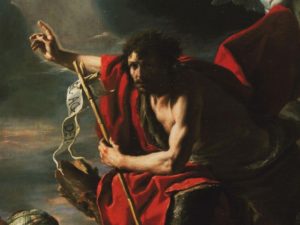 The lectionary gospel reading for Advent 2 in Yr i is Matt 3.i–12, and it contains many foundational themes of eschatology, the coming of God, and judgement, which set u.s. upward nicely for thinking nigh Adventnot as the build-up to Christmas, but (as it should be) thinking about the Terminal Things.
This is one of those passages where it is particularly informative to compare the gospel accounts side past side; you can practice this with a printed text like Throckmorton'sGospel Parallels, or online using something like this site from the University of Toronto. The online version is user-friendly, just the print edition highlights differences more than clearly in its layout.
We can see immediately the unlike interests of the gospel writers. Luke locates the beginning of John'due south ministry in the larger world of the Roman empire, whilst the Fourth Gospel doesn't explicate either John'south ministry or Jesus' baptism, but assumes y'all already know about it from reading the other gospels. There is an interesting contrast between Matthew and Marking's ordering of elements (which I am non sure commentaries pick upward) which is striking since, in other respects, Matthew follows Marker quite closely. Mark introduces John the Baptiser in this order:
OT prophecy—John's preaching (and baptism)—the people's response—John's appearance
just Matthew introduces the elements in this society:
John's preaching—OT prophecy—John'south advent—the people's response (and baptism)
It is characteristic of Matthew to describes something, and then explain how this fulfils OT prophecy, as we have seen (or will run into) in the nativity account. He appears to desire to emphasise John's appearance up forepart, which (of form) identifies him with Elijah.
Matthew's opening phrase 'In those days…' is very general, and follows the blueprint of Marker'southward 'In those days…' with reference to Jesus in Mark 1.9. It sits rather oddly in Matthew'due south account, since he has already been talking about the events around Jesus' birth, and these events are now decades later. (We only know from Luke that John and Jesus are about the same historic period.)
Although Matthew introduces John as 'the baptiser', his accent is constantly on his preaching. He appears 'in the wilderness', which is not just a physical location, but one meaning with theological significance, both for the people as a whole and for John himself. The wilderness was the scene of the Exodus wanderings, a period of testing and refinement too as a period of the presence of God with his people. But information technology is also the place of new beginnings when the people have strayed from God, a place where God volition once more than woo and win his people (Jer 2.2–3, Hos 2.14–15, Ezek 20.35–38). And information technology is the identify through which God will call his people habitation from exile in Is 40.3, which Matthew then cites. For John, the wilderness is also the home of Elijah, whose clothing he also wears (see ane Kings 17.3–vii and 2 Kings ane.8). Locusts were a common and practical food source, and are still eaten in the region—merely they also signify the nutrition of someone who eats what God has provided, rather than food he has worked for, echoing the promise of God that the state will exist 'flowing with milk and dear', things that you gather rather than work for (in contrast to the sowing and harvesting of grain).
Matthew consistently records Jesus and others talking about the 'kingdom of the heavens' rather than the 'kingdom of God' as institute in Marker and Luke. It has been argued that this is Matthew'southward Jewish tendency to avoid using the proper noun of God—merely he does employ the phrase 'kingdom of God' on occasion (as in Matt 12.28, 19.24), and elsewhere does not avoid 'God'. Then it is perhaps but stylistic, though it does emphasis the divine origin of all that will happen, in dissimilarity with other more political expectations of the Davidic messiah.
The nature of the 'kingdom of God/heaven' has been debated at bang-up length in scholarship in the by, though there is less debate about it currently. The consensus is that, rather than referring to a territory or an object, information technology is really referring to the dynamic nature of the reign of God, based on the OT idea of God equally king of both his people and the whole earth. It is key to the teaching and ministry of Jesus in the Synoptic gospels, and the hope for the kingdom of God (almost never abbreviated simply to 'the kingdom' in the gospels) has get central to Christian prayer.
Matthew'south summary of John's (and Jesus') declaration 'The kingdom of heaven has arrived' might thus be paraphrased every bit 'God's promised reign is beginning' or 'God is at present taking control'. (R T France, NICNT, p 102)
This is at every point continued to the fulfilment of hope from the OT, but it cannot exist detached from the linguistic communication of apocalyptic eschatology. The reason that God'due south reign needs to come is because all is non right with the world as it is, and because it is dominated by other kingdoms which oppose God's own volition and rule.
The Lord will go king over all the earth; no that day the Lord will exist ane and his name i (Zech 14.ix)
Jewish longing for this coming kingdom is expressed in the closing words of the Kaddish prayer from the time of Jesus:
May God allow his kingship rule in your lifetime and in your days and in the whole lifetime of the house of Israel, speedily and presently.
What is remarkable here is John'south claim that the reign of God is comingin the ministry of the One who follows him, that is, in the person and the ministry of Jesus. This extraordinary Christological merits is reinforced by Matthew'south citation from Is 40.3. There, the messenger is preparing the mode for God himself—nonetheless John is preparing the way for Jesus, who is now to be addressed as 'Lord' in the manner that Isaiah calls God 'Lord'. In the coming of Jesus we see the coming of God to his people Israel.
John's ministry is taking place on the east bank of the Jordan, north of the Expressionless Body of water (come across John 1.28), and only 20 miles from Jerusalem, and then it is like shooting fish in a barrel for the crowds to come to him. Josephus tells united states of america that the crowds were and so great that Herod Antipas, rule of Galilee and Perea, thought at that place was a real risk of an insurgence (Ant 18.118). Where Luke notes that John rebukes the 'multitudes' who come up to him, Matthew, with his Jewish focus, identifies those rebuked equally 'Sadducees and Pharisees', 2 quite distinct groups who, between them, represent the establishment powers in Jerusalem.
Two questions are raised by John's preaching and anticipation of Jesus' ministry building.
The first is whether John is the last in the line of OT prophets, and Jesus is by contrast the first of the new thing God is doing—or whether John's and Jesus' ministry building have more in common with one some other. Information technology is mutual in Christian reading of the gospels to assume the quondam, but Matthew is bang-up to concur the 2 together, non to the lowest degree in attributing to John exactly same summary message as he will presently attribute to Jesus in his declaration of the arrival of the kingdom of sky.
In fact, John and Jesus' ministry have many things in mutual.
- The language of 'breed of vipers' in Matt 12.34 and 23.33
- The call to repentance in Matt 11.20–21, 12.41
- The importance of producing fruit in Matt 7.16–twenty and elsewhere
- The debate about the children of Abraham in Matt 8.11–12
- The fruitless tree being cut down and burned in Matt 7.nineteen
- Judgement by fire in Matt 5.22, xiii.forty–42, 50, 18.8–9 and 25.41
- The grain existence gathered in Matt 13.30
Jesus in Matthew sounds very much like John the Baptist! The image of the grain harvest is also found in Rev xiv.14–sixteen, gathered past 'ane similar a son of human being'.
The 2d question is whether John is right in associating Jesus' ministry building with judgement. John'southward anticipation of Jesus' ministry:
"I baptize you with h2o for repentance. Only after me comes one who is more powerful than I, whose sandals I am non worthy to conduct. He will cognominate you with (or 'in') the Holy Spirit and fire. His winnowing fork is in his hand, and he will clear his threshing floor, gathering his wheat into the barn and called-for up the chaff with unquenchable burn down." (Matt 3.11–12)
There are several significant images of eschatological judgement here. Outset, the hope of the Holy Spirit beingness poured out ('baptism' means existence immersed in or overwhelmed past) is connect with 'the terminal days' in Joel ii.28. Although we might naturally associate 'burn down' with the tongues of flame at Pentecost in Acts two, only in fact it is an prototype of judgement, equally the phrase 'unquenchable burn' makes clear. (Two interesting things to note here. Showtime, the Greek term for 'unquenchable' isasbestos from which nosotros get, well, asbestos! 2nd, burn down is primarily an image of devastation, not torment.) John seems to look Jesus to be 1 who will bring the judgement of God to his people and to the wider world.
In Luke'due south gospel, there is a sense that judgment is postponed until the end of Jesus' ministry, with an intervening catamenia of grace creating an opportunity to answer. Matthew is less reluctant to tape the language of sentence in the educational activity of Jesus, and this is particularly noticeable in Jesus' six-fold use of the phrase 'weeping and gnashing of teeth' in Matt 8.12, xiii.42, 13.fifty, 22.13, 24.51 and 25.30.
The coming of the kingdom of heaven means the coming of the longed-for presence of God with his people. Simply that will likewise hateful a claiming to the reigning powers of this world, and the personal challenge to u.s.: to whom exercise you lot owe your allegiance? Volition y'all respond to the urge call to welcome what God is now doing, and modify your means and your priorities? And this challenge comes near sharply in the ministry of Jesus himself, who will ane solar day return every bit judge and king over all the earth.
John is right virtually judgement and Jesus, with two important qualifications. The showtime is that this judgement is postponed—in the instance of Israel until the destruction of the temple in 70AD, and in instance of all humanity until the render of Jesus as judge at the terminate of the age. And the 2nd qualification is that the basis of judgement shifts; for John information technology is avoided by repentance, baptism and the fruit of that alter in tangible change of life. In Jesus' teaching this is taken upward into the question of decision about following him: judgement is no longer on the footing of existence function of the ethnic Jewish people of God; nor on the basis of whether we alter and brainstorm to obey God'due south merely commandments; merely it is now on the basis of being incorporated into the renewed people of God by accepting Jesus as Lord, and living a new life of holiness empowered by the Spirit. And all this is possible just because of Jesus' atoning death and resurrection for us.
If you enjoyed this, practise share it on social media, perchance using the buttons on the left. Follow me on Twitter @psephizo.Like my page on Facebook.
Much of my piece of work is done on a freelance basis. If you have valued this mail, would you considerdonating £1.xx a month to support the production of this blog?
If you enjoyed this, exercise share information technology on social media (Facebook or Twitter) using the buttons on the left. Follow me on Twitter @psephizo. Similar my page on Facebook.
Much of my work is done on a freelance basis. If you lot accept valued this post, yous can make a unmarried or echo donation through PayPal:
Comments policy: Good comments that engage with the content of the mail service, and share in respectful debate, tin can add real value. Seek first to understand, so to be understood. Brand the most charitable construal of the views of others and seek to learn from their perspectives. Don't view debate as a conflict to win; address the statement rather than tackling the person.
leachmanweepleget.blogspot.com
Source: https://www.psephizo.com/biblical-studies/john-the-baptist-and-the-judgement-of-jesus-in-matt-3/
0 Response to "John the Baptist and the judgement of Jesus in Matt 3"
Post a Comment